-
Events
See all events here




-
Membership

Open to all those studying or working in transport planning, or related fields, on a professional basis.

Keith Buchan: We’re all in the Pink (and in the Red)
We’re all in the Pink (and in the Red)
Some of you will have heard of the Treasury Green Book – which assesses the costs and benefits of all Government spending. Or even the Magenta Book, which considers its mirror image: monitoring and evaluation. But I bet only a few of you have heard of the Pink Book. Google it and ignore the Amazon offers and you will see it contains the national statistics on the Balance of Payments – usually known as BOP.
The BOP falls out of fashion
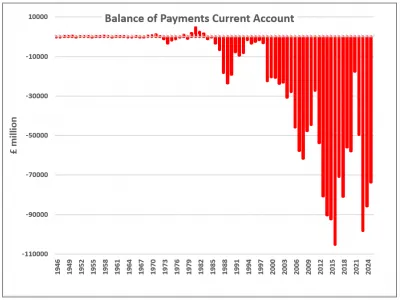
Once upon a time a few decades ago Chancellors of the Exchequer used to really obsess about BOP – broadly speaking the difference between what we as a nation spend abroad and what we earn. More recently it has fallen out of fashion but underlies key questions like who owns what in Britain – from football clubs to water companies – and the ability of Government to borrow money. Essentially it is a measure of how we pay our way in the world as UK plc and, as the chart below shows, recent decades have shown a dramatic change for the worse in the UK’s trading position. As will become clear air travel and road transport have a major role in this decline.
Source: https://www.ons.gov.uk/economy/nationalaccounts/balanceofpayments/timeseries/hbop/pnbp
While our exports of goods fell from the sixties onwards we made up for it by selling our services, such as finance and insurance - nowadays including transport planning! But something was going clearly going wrong from the late 80s onwards, masked in part by North Sea oil exports until the early 2000s.
Why doesn’t this issue command as much attention as it did in the 1970s? One reason is that it’s quite hard to work out exactly what the impact of the BOP is. In a simple economy a negative BOP would probably result in two things: currency devaluation and selling assets. In times before credit cards and globalisation nations might even try to stop people taking cash out of the country to make sure they spent it in the UK (the limit was £50 in Britain in the sixties!). Although entirely separate from Government debt it will also have an influence on the interest we currently pay on public borrowing.
Why should we bring back the BOP?
And why is this relevant to transport? The reason is that transport is very significant in the BOP story. There are two key areas: holiday air travel and road transport. To paint a picture: removing their BOP deficits would pretty much put the national accounts in order.
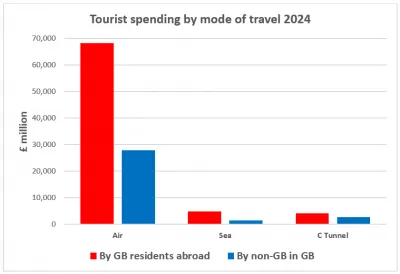
I haven’t got any data as to whether the Victorians had an equivalent tourism imbalance, either through the “Grand Tour” or Thomas Cook starting lower cost excursions (FYI it was by train to Loughborough in 1841). However it is clear that GB residents spend much more abroad than non-GB residents spend in GB. Drilling down into the detail the source mode is very clear.
Sources: https://www.ons.gov.uk/peoplepopulationandcommunity/leisureandtourism/datasets/ukresidentsvisitsabroad and https://www.ons.gov.uk/peoplepopulationandcommunity/leisureandtourism/datasets/overseasresidentsvisitstotheuk
The data on this is survey based but should be reliable for comparative purposes. It is the opposite of the 1970s, pre no-frills flying, when the UK had a tourism surplus. There are complicating factors such as UK based spending to support a holiday (such swimming costumes) but this is nothing like enough to balance out the deficit. And they’re probably made in China anyway.
International aviation is a more complex picture on the fuel side, for example due to use by non-UK airlines. This is included in the next issue: fuel for transport.
Fuelling the BOP
When North Sea Oil came into the picture we were for a short time a petro-state (production peaked between the 1980s and 1990s). But in 2024 the UK produced a quarter of what it did in 1995. As production fell BOP became an issue. This can be clearly seen in the figure below.
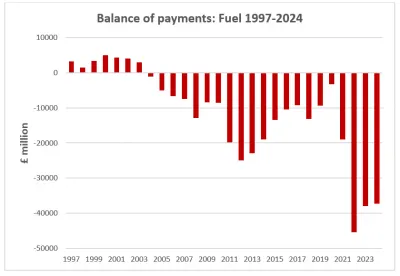
Source: 2024 Pink Book
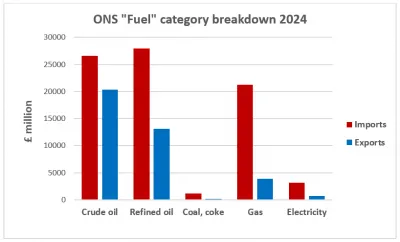
Oil is important for us as transport planners because so much of it is used to move goods and people, and most of that for road and aviation transport. Of course, not everything defined as “Fuel” is refined oil for transport. Digging into the numbers shows that oil is nevertheless the key component and still has a serious BOP deficit. This is shown in the chart below which covers 2024.
It’s hard to separate out how the BOP is compensated for in the UK because the financial sector is so significant and currency fluctuations happen for other reasons (like Brexit or oil production). The Pink Book is full of detail on these issues. Selling assets is also complicated but other studies show that there has been huge investment by non-UK residents and governments in UK property and obviously some rather well known premier league football clubs. Conflation of the two is confusing for the public – asset selling sounds bad, investment sounds good. Houses and flats bought by non-UK residents in London or Man United sold to foreign investors (bad?), versus a biotech factory being built (good?).
While researching this report the whole oil market (and others) has been thrown into turmoil by events in the Straits of Hormuz. But the underlying trends remain the same, it’s the arguments for doing something about them that have actually become a whole lot stronger.
What should transport planners make of this?
First it is clear that reducing fuel consumed has a clear BOP benefit – whether from demand management or longer term electrification. Add BOP benefits to energy security. Both are of course added to climate change mitigation to pretty much make the policy overall essential rather than desirable. It is clear that the decarbonisation of the UK’s transport and energy systems has some very real if hard to value economic benefits to set against any transition costs of moving to a low carbon, low waste economy. That argues strongly against the calls to delay electrification.
Second that the expansion of leisure travel outside the UK, which is what drives aviation growth both in the recent past and in the forecasts, will increase BOP problems as well as accelerating climate change. All of which makes airport expansion look like an increasingly lose-lose situation. Whatever you think about current levels of air travel, expanding it would be grossly irresponsible.
Isn’t it time all transport planners stood up and said so?
Keith Buchan has worked on appraisal issues for over 30 years and is one of the leads on the subject for the TPS Policy Panel. The underlying research for this blog is from his work on tax and appraisal issues with the New Transport Taxation Group (NTTG) on https://transportfiscal.org.uk/
NTTG is supported by TPS and the Foundation for Integrated Transport.


TPS is supported by